
Ser vs. Estar: Finally Understand the Difference Without Memorizing Endless Rules
One of the first challenges every Spanish learner faces is understanding when to use ser and when to use estar. Although both mean “to be” in English, they express different…
One of the first challenges every Spanish learner faces is understanding when to use ser and when to use estar. Although both mean “to be” in English, they express different ideas in Spanish. The good news? Once you understand the logic behind them, choosing the right verb becomes much easier.
In English, things are simple:
I am American.
I am happy.
I am a teacher.
I am at home.
In all these examples, English uses the same verb: to be.
In Spanish, however, different situations require different verbs:
Soy estadounidense.
Estoy feliz.
Soy profesor.
Estoy en casa.
That’s where many learners start feeling confused.
So how do you know which one to use?
That’s exactly what you’ll learn in this guide.
The Golden Difference
Many textbooks teach:
SER = permanent
ESTAR = temporary
This rule is helpful for beginners.
But it is not the complete story.
In fact, one reason students struggle with Ser and Estar is because they learn this rule and then quickly discover situations where it doesn’t work.
For example:
Costa Rica está en Centroamérica.
(Costa Rica is in Central America.)
That’s not temporary.
Yet Spanish uses estar.
Or:
Mi abuelo está muerto.
(My grandfather is dead.)
That isn’t temporary either.
Yet Spanish still uses estar.
So what is really happening?
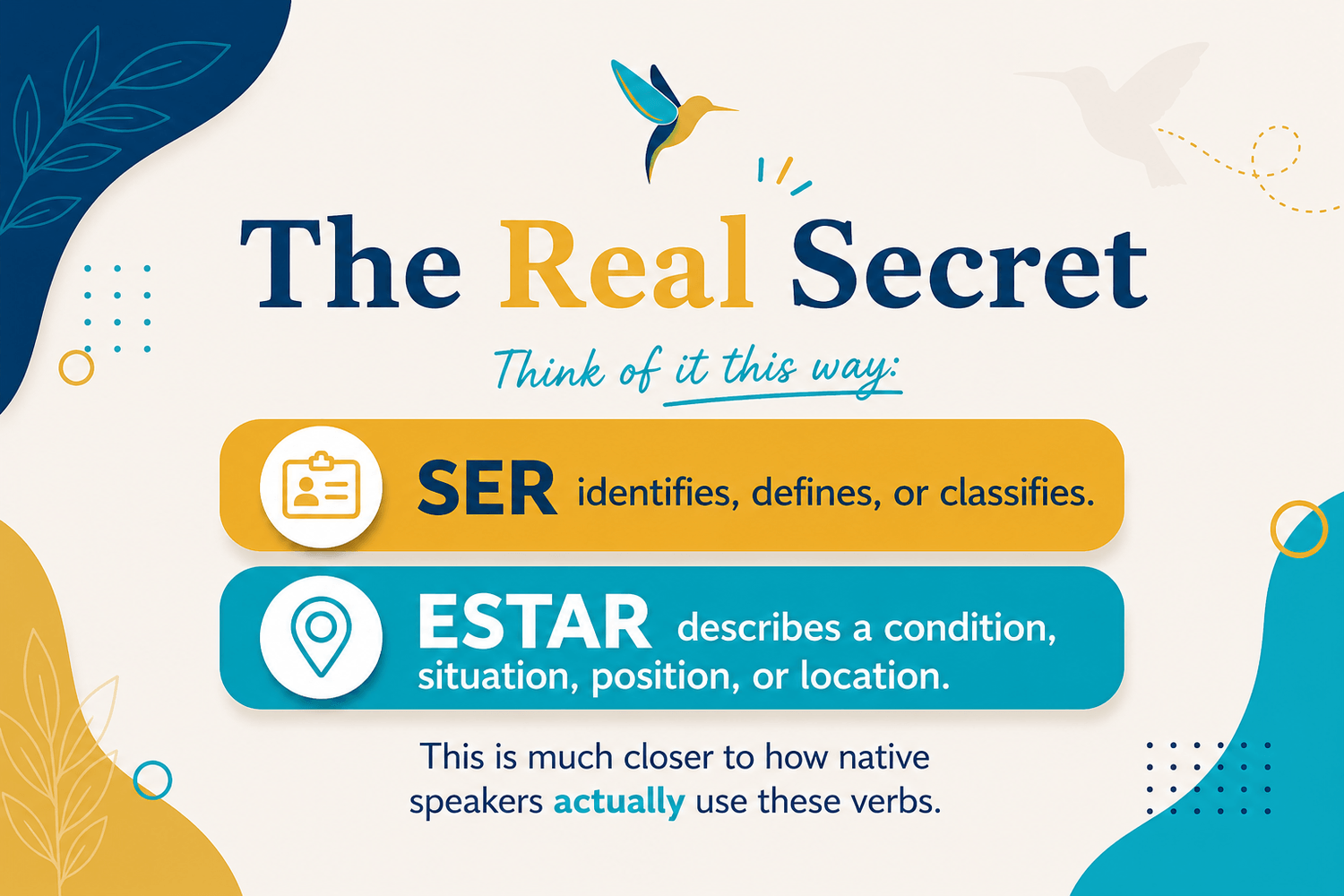
Think of SER as an Identity Card
SER answers questions like:
Who are you?
What are you?
Where are you from?
What defines you?
What category do you belong to?
SER helps identify something. Examples:
Yo soy Ana.
(I am Ana.)
Why SER?
Because your name identifies you.
Soy profesora.
(I am a teacher.)
Why SER?
Because your profession helps identify you.
Somos costarricenses.
(We are Costa Rican.)
Why SER?
Because nationality identifies origin.
Ella es inteligente.
(She is intelligent.)
Why SER?
Because intelligence is presented as part of her character.
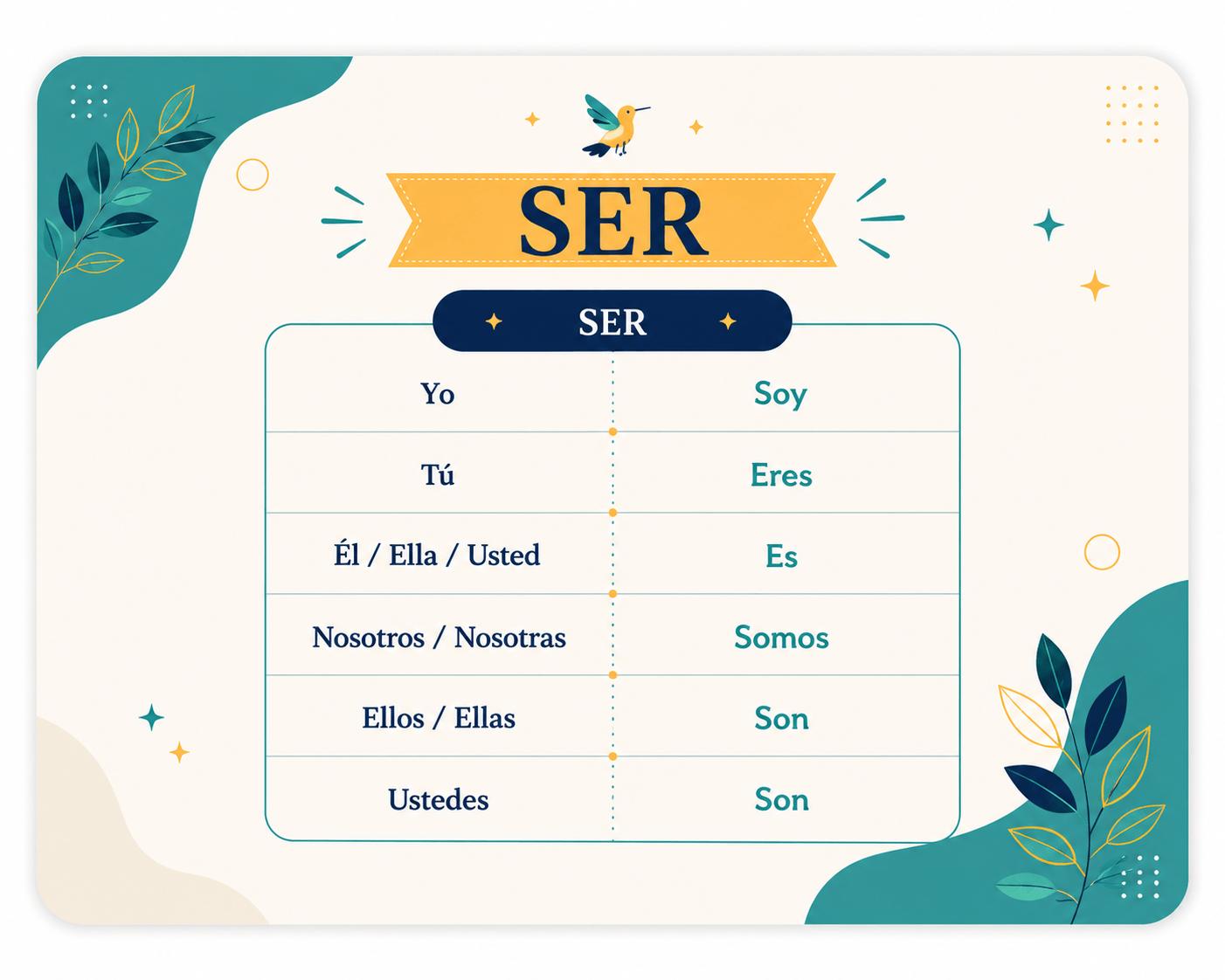
Present Tense Conjugation of SER
The DOCTOR Trick for SER
Many Spanish teachers use the acronym DOCTOR to remember the most common uses of SER.
It is not the rule itself.
It is simply a memory tool.
D = Description
Él es alto.
(He is tall.)
La mesa es redonda.
(The table is round.)
These characteristics help identify something.
O = Occupation
Mi hermana es médica.
(My sister is a doctor.)
Juan es profesor.
(Juan is a teacher.)
Occupation identifies what a person does.
C = Characteristics
Ella es amable.
(She is kind.)
Carlos es tímido.
(Carlos is shy.)
These traits describe personality.
T = Time and Dates
Hoy es lunes.
(Today is Monday.)
Son las tres y media.
(It is 3:30.)
Spanish always uses SER for days, dates, and time.
O = Origin
Somos de Costa Rica.
(We are from Costa Rica.)
El café es de Colombia.
(The coffee is from Colombia.)
Origin tells us where something comes from.
R = Relationships
Ellos son mis padres.
(They are my parents.)
María es mi amiga.
(María is my friend.)
Relationships help identify connections between people.
Other Common Uses of SER
Ownership
El libro es mío.
(The book is mine.)
The owner helps identify the object.
Nationality
Ella es mexicana.
(She is Mexican.)
Nationality identifies origin.
Physical Description
Mi vecino es alto y delgado.
(My neighbor is tall and thin.)
These characteristics help distinguish him from others.
Classification
Este restaurante es italiano.
(This restaurant is Italian.)
The restaurant belongs to a category.
Remember This!
When the information answers:
“What is it?”
“Who is it?”
“What defines it?”
SER is often the correct choice.
But what about emotions, locations, conditions, and situations?
That’s where ESTAR comes in…
What ESTAR Really Means
Now that you understand SER, let’s look at ESTAR.
If SER is about identity, definition, and classification, ESTAR is about something very different.
Think of ESTAR as answering questions like:
Where is it?
How is it?
What condition is it in?
What is happening right now?
ESTAR focuses on a person’s or thing’s current situation, condition, position, or location.
This is why ESTAR is often associated with temporary situations, but remember:
Temporary is a helpful clue, not the real rule.
The real question is:
Am I describing a condition, situation, position, or location?
If the answer is yes, ESTAR is usually the correct choice.
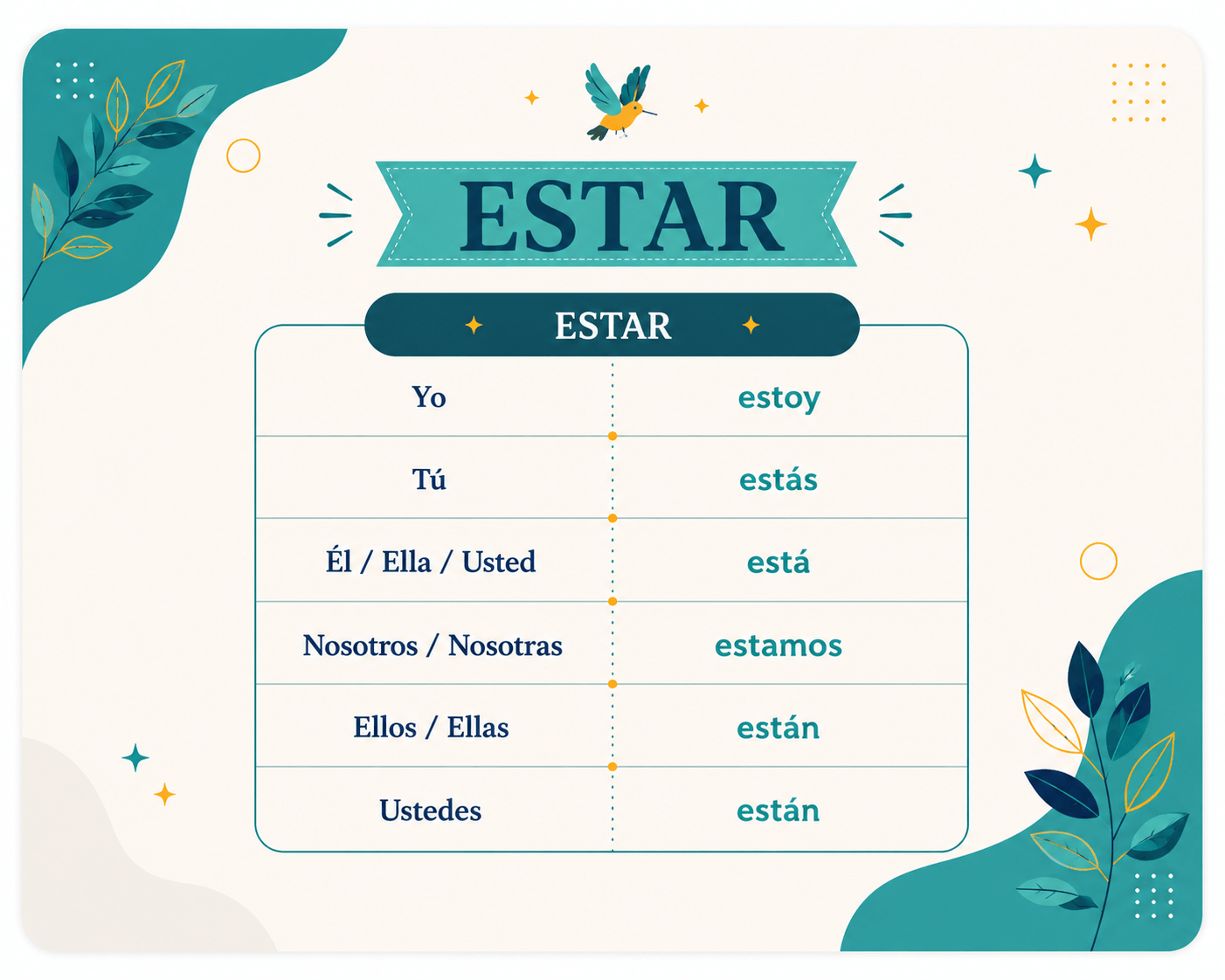
Present Tense Conjugation of ESTAR
The PLACE Trick for ESTAR
Just like DOCTOR helps us remember SER, PLACE helps us remember the most common uses of ESTAR.
Remember:
PLACE is a memory tool, not the actual rule.
P = Position
Position describes how someone or something is physically placed.
Estoy sentado.
(I am seated.)
Why ESTAR?
Because sitting is a position.
El gato está acostado.
(The cat is lying down.)
Why ESTAR?
Because we’re describing its physical position.
L = Location
This is one of the easiest uses of ESTAR.
When talking about where people or things are located, Spanish usually uses ESTAR.
La biblioteca está en la esquina.
(The library is on the corner.)
Mis hijos están en la habitación.
(My children are in the room.)
Estamos en París.
(We are in Paris.)
Why ESTAR?
Because location is not identity.
It tells us where something is, not what it is.
A = Action
ESTAR is used with the present progressive. This is similar to English “-ing” verbs.
Estoy estudiando español.
(I am studying Spanish.)
Ellos están comiendo.
(They are eating.)
Mi esposa está trabajando.
(My wife is working.)
Why ESTAR?
Because the action is happening right now.
C = Condition
This is one of the most common uses.
Ella está cansada.
(She is tired.)
Él está enfermo.
(He is sick.)
Nosotros estamos ocupados.
(We are busy.)
Why ESTAR?
Because we are describing a condition or situation.
E = Emotion
Emotions usually use ESTAR.
Estoy feliz.
(I am happy.)
Está preocupada.
(She is worried.)
Estamos emocionados.
(We are excited.)
Why ESTAR?
Because emotions are viewed as states or conditions.
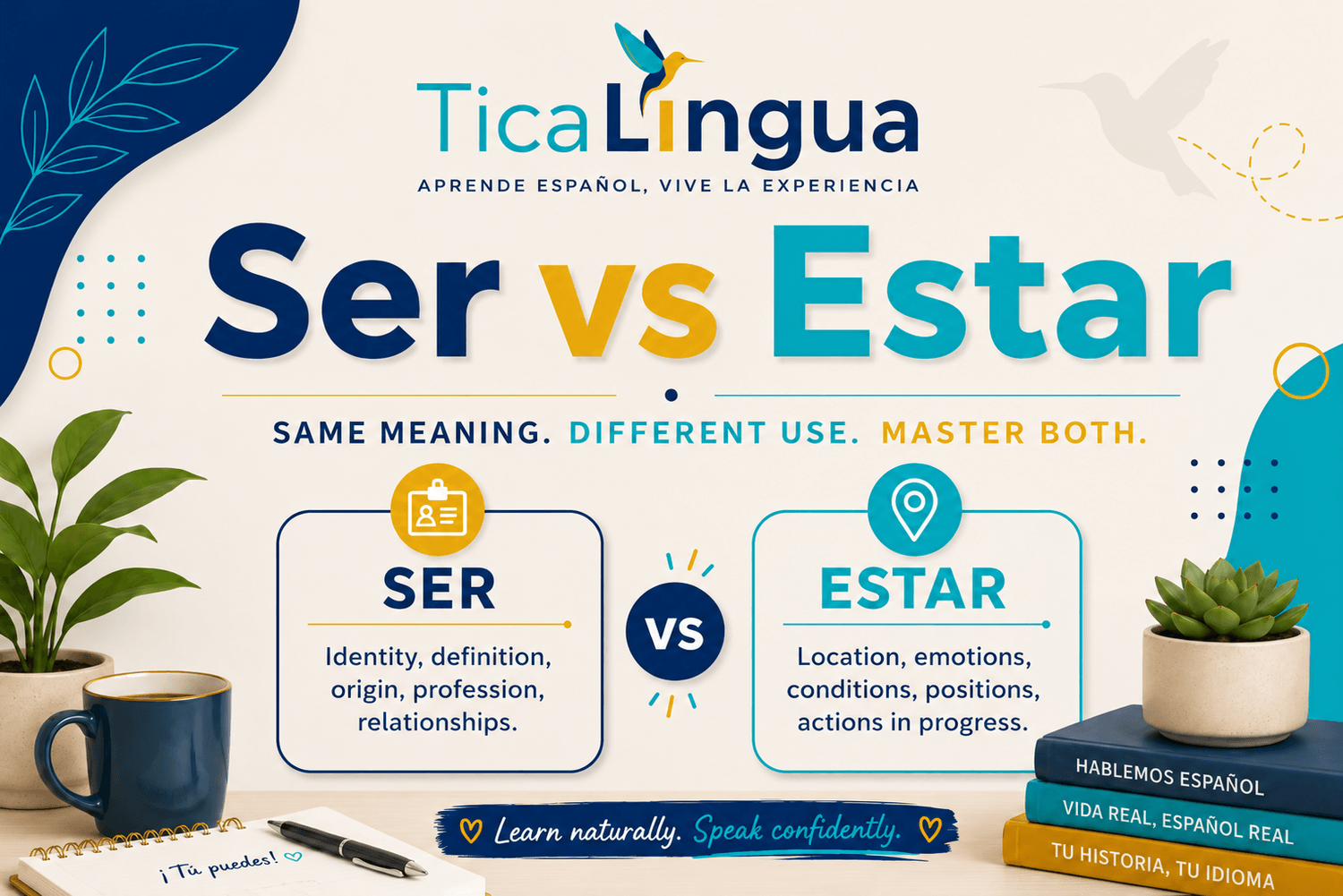
Examples:
Soy profesora.
Being a teacher is part of how I identify myself.
Estoy cansada.
Being tired is a temporary condition.
So far, the rule works.
But then Spanish starts doing interesting things.
When the Rule Breaks
Languages love breaking their own rules.
Spanish is no exception.
Example 1
Costa Rica está en Centroamérica.
Costa Rica’s location is not temporary.
Yet Spanish uses ESTAR.
Why?
Because Spanish sees this as location, not identity.
Example 2
La puerta está cerrada.
The door is closed.
The door may stay closed all day.
Yet Spanish uses ESTAR.
Why?
Because we’re describing its condition.
Example 3
Mi abuelo está muerto.
Death is not temporary.
Yet Spanish uses ESTAR.
Why?
Because Spanish views death as a state or condition.
Watch Out!
Native speakers are usually NOT asking: “Is this permanent?”
Instead, they are asking: “Am I describing what this is?”
→ SER
Or:
“Am I describing its condition, situation, position, or location?”
→ ESTAR
This small change in perspective makes Ser vs. Estar much easier.
SER vs. ESTAR: Same Adjective, Different Meaning
This is where Spanish gets really interesting.
Sometimes both verbs are possible. But the meaning changes.
Es aburrido vs. Está aburrido
Pedro es aburrido.
(Pedro is boring.)
Pedro’s personality makes people bored.
Pedro está aburrido.
(Pedro is bored.)
Pedro feels bored right now.
Es nervioso vs. Está nervioso
Ana es nerviosa.
(Ana is a nervous person.)
Part of her personality.
Ana está nerviosa.
(Ana is nervous.)
Something is making her nervous right now.
Es listo vs. Está listo
Carlos es listo.
(Carlos is smart.)
Carlos está listo.
(Carlos is ready.)
Completely different meaning.
Es rico vs. Está rico
Mi vecino es rico.
(My neighbor is rich.)
La comida está rica.
(The food is delicious.)
One adjective, two very different meanings.
Es orgulloso vs. Está orgulloso
Ella es orgullosa.
(She is proud/arrogant.)
Personality trait.
Ella está orgullosa.
(She is proud.)
A feeling in a specific situation.
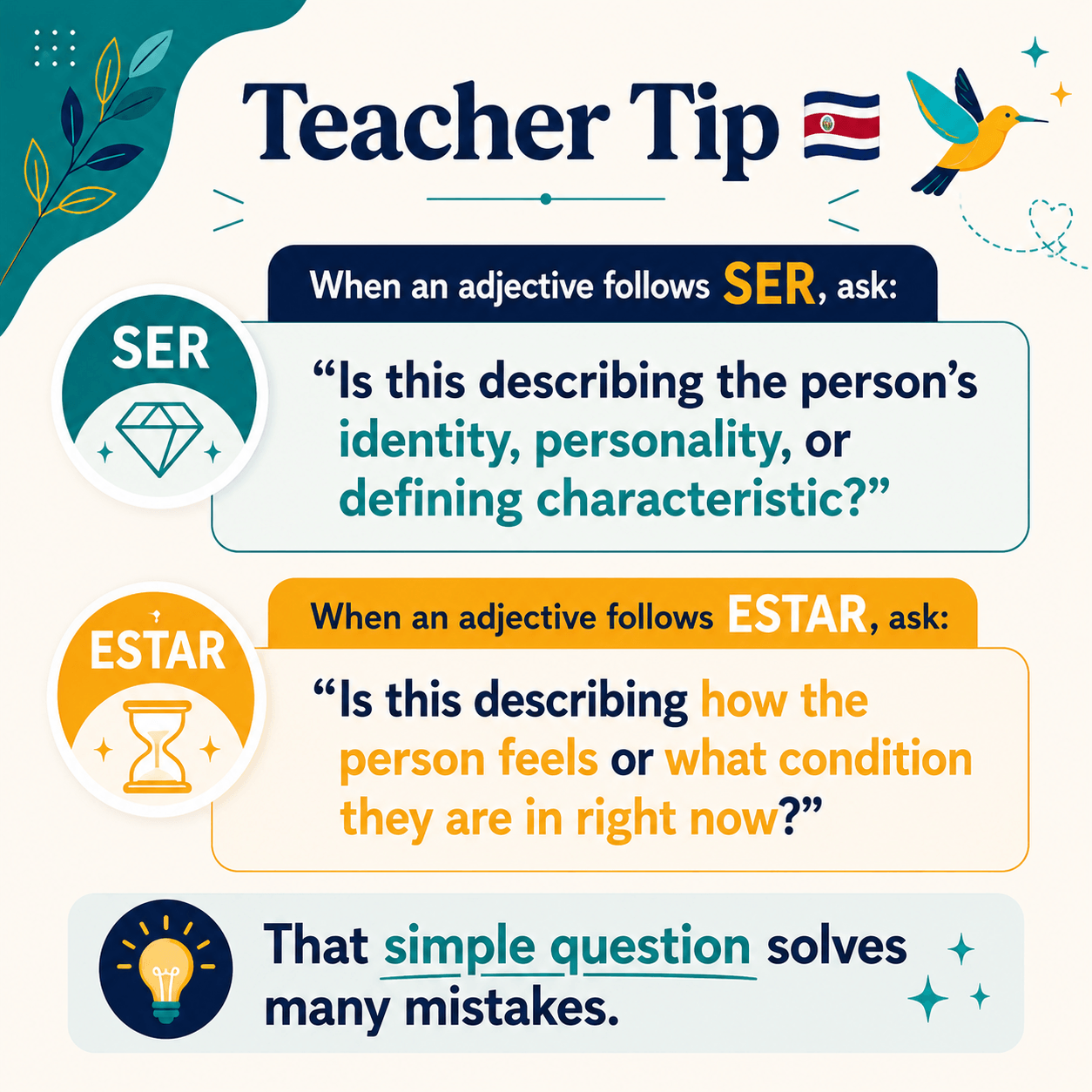
Final Summary
If there is one thing to remember from this lesson, it is this:
SER tells us what something is.
ESTAR tells us how, where, or in what condition something is.
At first, choosing between these two verbs may feel confusing—and that’s completely normal.
Many beginners start with the shortcut:
SER = permanent
ESTAR = temporary
And while that rule can be helpful, it doesn’t explain every situation. As you’ve seen, Spanish sometimes breaks its own rules.
That’s why understanding the meaning behind each verb is much more powerful than memorizing lists.
When you’re speaking, ask yourself:
Am I describing identity, origin, profession, relationships, or something that defines a person or thing?
→ Use SER
Am I describing a location, emotion, condition, position, or situation?
→ Use ESTAR
The good news is that you don’t need to master everything today.
The more Spanish you read, hear, and speak, the more natural this choice will become.
Don’t aim for perfection.
Aim for communication.
Every conversation is practice, and every mistake is part of the learning process.
Now it’s your turn.
Complete the practice activities below and see how many SER and ESTAR decisions you can make on your own. You may be surprised by how much you already understand.
Let’s practice!
COMPARTE


Suscríbete ahora.
Regístrate a nuestra newseletter para recibir las historias más interesantes del día directo en tu correo electrónico antes que cualquier persona
Creado con ©systeme.io• Política de Privacidad • Términos del servicio